Beyond Tech: 3 ‘Hidden’ Japanese Growth Sectors You’ve Overlooked
When you think of Japan’s economy, big tech names like Sony or Toyota probably come to mind. But there’s a shift happening under the radar. Japan is investing in less obvious sectors that are thriving due to its aging population, government policies, and market inefficiencies. Here’s a quick look at three areas ripe for investment:
- Healthcare and Medical Services: Aging demographics are driving demand for eldercare, chronic disease management, and AI-driven health solutions. Government incentives and real estate needs for specialized facilities add to the sector’s appeal.
- Data Centers and Digital Infrastructure: Japan’s AI and cloud investments are booming. With government-backed projects like the “Gov-Cloud” and cybersecurity funding, this sector offers long-term growth tied to digital transformation.
- Hobby and DIY Retail: Shrinking population trends are shifting consumer preferences toward premium, niche products. This sector also presents opportunities for acquisitions, especially among small businesses facing succession issues.
These sectors offer diverse entry points for investors, from high-capital healthcare and digital infrastructure projects to smaller-scale retail acquisitions. Success requires understanding Japan’s unique market dynamics and a commitment to long-term growth.
1. Healthcare and Medical Services
Market Growth Potential
Japan’s rapidly aging population is reshaping the healthcare landscape. With a growing need for geriatric care, chronic disease management, and dementia-related services, the sector is evolving quickly. This shift is creating immediate opportunities for eldercare facilities, specialized medical services, and advancements in regenerative medicine. Government initiatives are playing a pivotal role in driving these changes, offering a supportive environment for growth.
Key Drivers and Trends
The Japanese government is actively promoting advancements in AI, biotechnology, and digital health through tax incentives, grants, and simplified regulations. These measures are attracting both local and international investments, making it an appealing market for companies offering solutions to demographic-driven challenges. Foreign businesses that bring efficiency-boosting and quality-of-life-enhancing innovations are especially well-received, as these technologies address some of Japan’s most urgent societal needs.
Investment Opportunities
The aging population presents a wealth of opportunities for businesses addressing age-related challenges. Digital health platforms, AI-powered diagnostic tools, and biotech innovations targeting chronic illnesses are key areas of interest. Additionally, companies creating caregiving technologies designed to improve daily life for the elderly are well-positioned to thrive in this market.
Real Estate Tie-ins
The expansion of healthcare services is also driving demand for specialized real estate. As the need for geriatric and dementia care grows, purpose-built facilities with tailored designs and accessibility features are becoming essential. Regions with higher concentrations of elderly residents are particularly attractive for such developments. Investors who recognize the connection between healthcare delivery and real estate infrastructure can tap into this growing demand.
2. Data Centers and Digital Infrastructure
Market Growth Potential
Japan’s digital infrastructure is expanding at an impressive pace, fueled by a projected $66 billion AI investment by 2030. In November 2025, Prime Minister Sanae Takaichi’s administration reintroduced a “state-led growth strategy”, prioritizing digital infrastructure as a key investment area. The domestic cybersecurity market, which hit $9.66 billion in 2022, is forecasted to grow annually by 8-9% in the coming years. This growth aligns with Japan’s broader economic strategy, particularly as the country faces a looming labor shortage of 11 million workers by 2040. These factors underscore the critical role digital infrastructure will play in shaping Japan’s economic trajectory.
Key Drivers and Trends
The AI surge is at the heart of Japan’s digital transformation. In 2025, the Digital Agency launched the “Government Cloud (Gov-Cloud)” initiative, which brought together global players like Amazon Web Services and Google Cloud with domestic heavyweights such as NEC, NTT, Fujitsu, and Sakura Internet to create a unified cloud platform. NTT introduced its large language model “Tsuzumi”, while Fujitsu teamed up with Cohere to advance AI capabilities for the Japanese language. To support these advancements, the government is offering corporate tax incentives and subsidies for data center development, along with a 2024 budget allocation of $1.406 billion dedicated to cybersecurity.
Investment Opportunities
The shift to a cloud-first approach opens up numerous opportunities for investors. Digital transformation is no longer optional in industries like manufacturing, logistics, retail, hospitality, and financial services. This shift drives demand for software solutions, IoT devices, AI-powered analytics, and robust cybersecurity platforms. In 2025, the Financial Services Agency established an innovation promotion office to streamline FinTech regulations and create business opportunities, even offering a dedicated contact point for foreign companies.
As Richard Mort, Strategic Intelligence Consultant at The Human API, puts it: “Japan won’t lead in foundational AI technology. That ship has sailed to California. But Japan’s competitive advantage lies in applying AI – embedding it into processes, using ‘AI agents’ to integrate systems, and leveraging decades of kaizen discipline”. These advancements are not just reshaping technology but also redefining investment opportunities, aligning with Japan’s broader economic evolution.
Real Estate Tie-ins
The rapid growth of digital infrastructure is also driving changes in physical infrastructure. The expansion of cloud services and data centers requires specialized facilities with reliable power grids, advanced cooling systems, and strong connectivity. These purpose-built properties are becoming essential assets. With the government treating “cloud for AI” as a cornerstone of national infrastructure, the demand for such facilities is only expected to increase. Investors who recognize the link between digital transformation and the physical spaces needed to support it can find opportunities in industrial properties that can be converted or developed into data centers, especially in regions with robust connectivity and power infrastructure.
5 Ways to Invest in Japan for Foreigners in 2025
sbb-itb-15a157d
3. Hobby and DIY Retail
Japan’s evolving economy is creating new avenues for growth in its consumer-focused sectors, especially in hobby and DIY retail.
Market Growth Potential
Japan’s hobby and DIY retail market is shifting, influenced by a declining population and a growing preference for quality over quantity. As the population shrinks, the demand for mass-market goods decreases, but this shift opens doors for premium products. Wolfgang Schattenmann, President of Wacker Asahikasei Silicone, explains:
When the population shrinks, the market needs fewer consumer products like shampoo and detergent. But new opportunities also emerge. Consumption often becomes higher quality, benefiting premium segments.
This shift is paving the way for retailers who focus on offering unique and high-quality products, catering to consumers who value distinctiveness.
Key Drivers and Trends
The rise of e-commerce is reshaping how Japanese consumers shop for hobby and DIY items. Online platforms are growing fast, and AI-driven personalization is taking customer engagement to the next level by tailoring product recommendations. Meanwhile, many small and medium-sized businesses in Japan are grappling with succession issues. This challenge creates opportunities for mergers and acquisitions, enabling foreign investors to acquire established companies with loyal customer bases. These trends highlight the potential for strategic market entries through acquisitions and innovative online retail strategies.
Investment Opportunities
Foreign investors have a couple of promising paths to explore in this sector. Acquiring niche Japanese businesses facing succession challenges offers a direct way to access the market. Beyond acquisitions, launching personalized online stores – especially when partnered with local expertise – can help investors carve out a strong presence in this growing market.
Investment Comparison by Sector
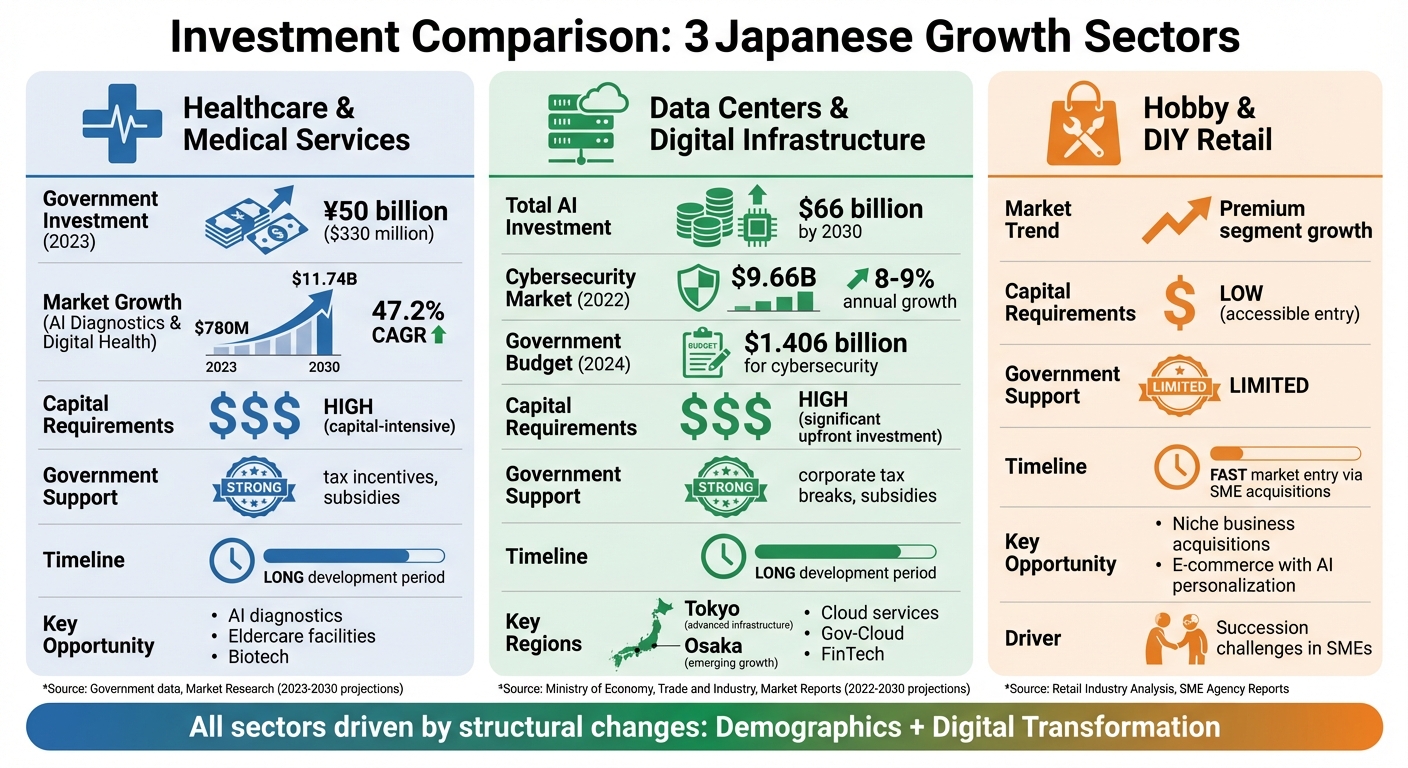
Japan Investment Sectors Comparison: Healthcare, Digital Infrastructure, and Hobby Retail
Each sector comes with its own capital demands and risk-reward dynamics. Let’s start with healthcare and medical services, a field that enjoys strong government backing. For instance, Japan has pledged at least $66 billion to the AI sector by 2030, including a ¥50 billion ($330 million) investment in Medical & Healthcare in 2023. AI diagnostics and digital health are expected to grow from $780 million to $11.74 billion by 2030, reflecting an average annual growth rate of 47.2%. These numbers underscore the sector’s long-term growth potential, though it remains capital-intensive compared to others.
Shifting to digital infrastructure, this sector benefits from focused government investments. Regional hubs like Tokyo and Osaka present distinct opportunities. Tokyo stands out for its advanced tech infrastructure, while Osaka’s increasing cloud demand signals emerging growth. Providers in this space are actively scaling their capacities to meet these regional demands.
On the other hand, hobby and DIY retail offers a more accessible entry point with lower capital requirements. Unlike healthcare or digital infrastructure, this sector doesn’t enjoy the same level of government support. However, it presents opportunities through the acquisition of small and medium-sized enterprises (SMEs) grappling with succession challenges. The premium market segment looks particularly promising as Japan’s aging and shrinking population shifts its focus toward higher-quality products.
The capital needs and timelines vary widely across these sectors. Investments in healthcare AI and data centers typically require significant upfront capital and longer development periods. However, they benefit from government incentives like corporate tax breaks and subsidies. In contrast, hobby retail acquisitions allow for faster market entry with lower initial investment, though success hinges on a solid understanding of local consumer behavior and succession trends.
Conclusion
Japan’s investment opportunities stretch far beyond its renowned tech industry. The three sectors discussed – healthcare and medical services, data centers and digital infrastructure, and hobby and DIY retail – highlight diverse entry points into Japan’s changing economy. These sectors are shaped by lasting structural changes rather than short-term market trends.
What makes these sectors stand out is their resilience to Japan’s economic cycles. They offer steady earnings growth fueled by long-term factors like demographic shifts and the push for digital transformation. This makes them appealing options for investors looking to diversify their portfolios.
The capital requirements differ across these sectors. Healthcare and digital infrastructure typically need significant upfront investments, often supported by government initiatives. On the other hand, the hobby and DIY retail sector presents opportunities for quicker small-to-medium enterprise (SME) acquisitions, especially as many businesses face succession challenges.
However, success in Japan demands more than just capital. It requires a deep understanding of local culture and a commitment to building long-term partnerships. Whether you’re exploring government-backed healthcare projects, urban data center developments, or retail SME acquisitions, having market knowledge and a sustained presence is key.
These emerging sectors provide foreign investors with a chance to engage in Japan’s structural evolution while stepping away from traditional tech investments. The real question isn’t whether these sectors will grow – but which one aligns best with your goals, resources, and expertise.
FAQs
What is driving the rapid growth of Japan’s healthcare sector?
Japan’s healthcare industry is on an upward trajectory, driven by a mix of powerful trends. One of the biggest factors is the country’s aging population, which is pushing up the demand for cutting-edge medical care and health technologies. This demographic shift creates a pressing need for solutions that can address age-related health challenges.
Government backing is another key element. Japan has been heavily investing in biotech and medical research, paving the way for advancements in areas like pharmaceuticals and regenerative medicine. This commitment is helping to accelerate breakthroughs that could reshape patient care.
On top of that, digital health technologies are changing the game. Tools like telemedicine and AI-based diagnostics are revolutionizing how healthcare services are delivered, making them more accessible and efficient. With Japan’s strong economy and its emphasis on technological progress, the healthcare sector is shaping up to be a hotbed of growth and investment potential.
How is Japan improving its digital infrastructure to support AI and cloud technology growth?
Japan is making bold moves to upgrade its digital infrastructure, keeping pace with the rapid expansion of AI and cloud technology. By 2023, more than 77% of companies in Japan had embraced cloud services, and projections suggest the market could nearly double by 2027. The AI sector is also on a remarkable upward trajectory, expected to grow from $6.6 billion in 2024 to an impressive $35.2 billion by 2033. This growth is fueled by initiatives like Society 5.0, which envisions a data-driven, human-focused society.
The Japanese government is playing a key role in this transformation, rolling out strategic policies, encouraging open-source solutions, and fostering collaborations between public and private sectors. These efforts are designed to establish Japan as a global leader in AI and cloud advancements, creating promising opportunities for investors looking to tap into these booming industries.
Why is Japan’s hobby and DIY retail sector an appealing investment opportunity for foreigners?
Japan’s hobby and DIY retail market is drawing interest from international investors, largely due to changing demographics. With an aging population, there’s a rising need for products like home improvement tools, caregiving essentials, and items that support independent living. Simultaneously, a surge in enthusiasm for personalized and creative hobbies is encouraging more consumer spending in this space.
On top of that, Japan offers a business-friendly environment. Incentives for niche markets and a vibrant startup scene provide fertile ground for fresh retail ideas. Together, these trends present a compelling opportunity for investors aiming to tap into Japan’s shifting economic landscape.
Related Blog Posts
changing demographics. With an aging population, there’s a rising need for products like home improvement tools, caregiving essentials, and items that support independent living. Simultaneously, a surge in enthusiasm for personalized and creative hobbies is encouraging more consumer spending in this space.
On top of that, Japan offers a business-friendly environment. Incentives for niche markets and a vibrant startup scene provide fertile ground for fresh retail ideas. Together, these trends present a compelling opportunity for investors aiming to tap into Japan’s shifting economic landscape.