
General Article
Do You Have to Rent an Office for a Japan Business Manager Visa? (2026 Update)
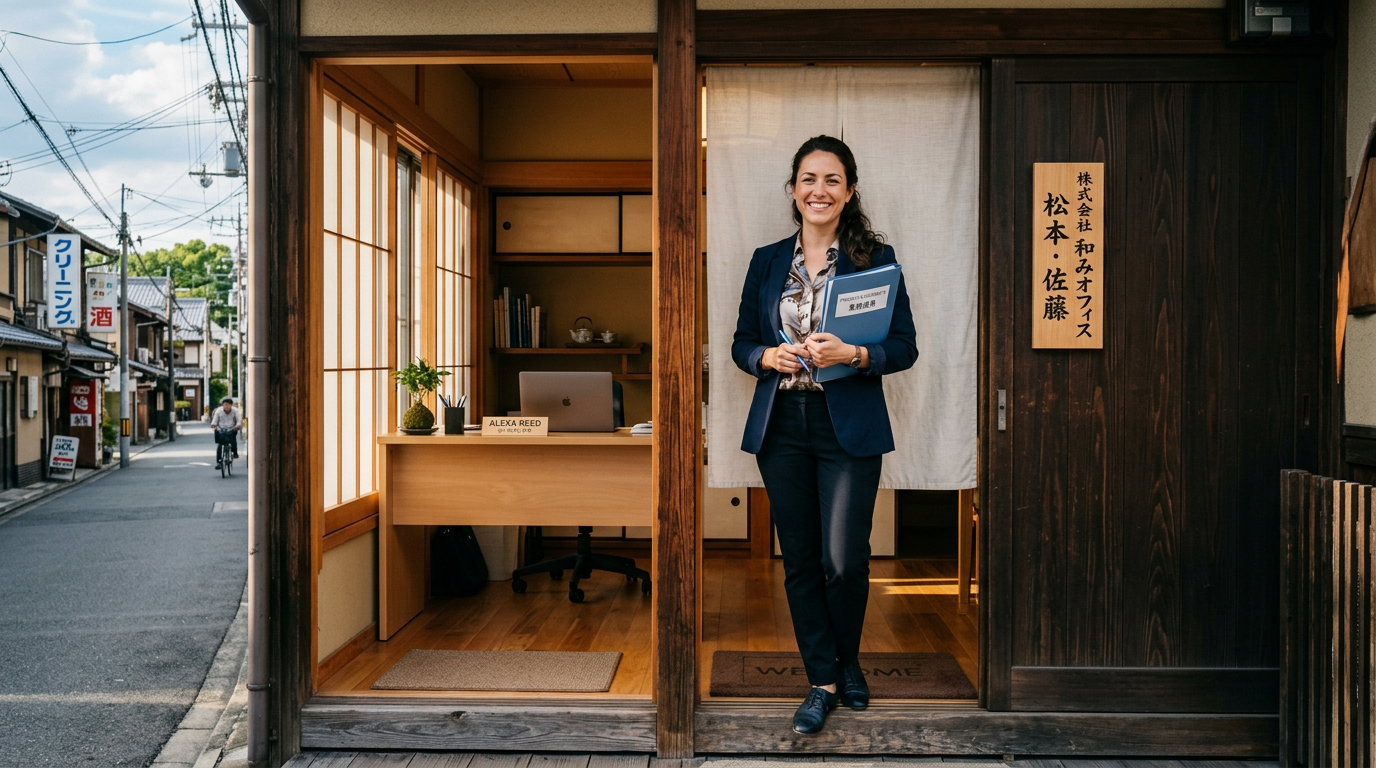
Short answer: Under Japan’s new 2026 rules, the old workarounds of home offices and co-working spaces have largely been closed off — but there are still smart, legal strategies to meet the office requirement without burning cash on a traditional lease. This guide explains exactly what changed, why it matters, and what your best options are right now.
What Is the Japan Business Manager Visa?
The Business Manager Visa (sometimes still called the “Investor/Business Manager” visa) lets foreign nationals live in Japan by sponsoring their own visa through a company they own and operate. Unlike a standard work visa where an employer controls your role, this visa gives you control over your professional life. You decide what your business does.
Key benefits include:
- Long-term residency — typically granted for one year initially, extendable up to five years
- Pathway to Permanent Residency — a 5-year Business Manager Visa period counts toward the PR eligibility timeline
- Business flexibility — you can run a short-term rental, consulting firm, restaurant, IT company, e-commerce business, and more
- Dependent sponsorship — you can sponsor a spouse, children, and under specific conditions, your parents
- Staff sponsorship — including a full-time cleaner or property manager (invaluable for short-term rental operators)
⚠️ Major 2026 Rule Changes You Must Know
Japan’s Immigration Services Agency issued sweeping revisions to the Business Manager Visa that took effect on October 16, 2025. If you read any guide written before late 2025, the core assumptions may now be outdated. Here is a full comparison of the old versus new requirements:
| Requirement | Before October 2025 | From October 2025 / 2026 |
|---|---|---|
| Minimum Capital | ¥5 million (approx. $33,000 USD) | ¥30 million (approx. $200,000 USD) |
| Employees | 2 full-time OR ¥5M capital | At least 1 full-time employee (mandatory) |
| Management Experience | Not required | 3+ years in a management/CxO role OR Master’s/PhD in a relevant field |
| Japanese Language | Not required | Required (employee must demonstrate Japanese ability) |
| Business Plan | Internal plan acceptable | Must be certified by a qualified professional (CPA, tax accountant, or SME consultant) |
| Office Space | Home office or co-working space possible in some cases | Independent physical office required in principle; home offices largely no longer accepted |
| Tax & Insurance Scrutiny | Standard checks | Strict review of tax compliance and social insurance obligations at renewal |
Important transition note: If you already hold a Business Manager Visa, you have a 3-year transition window from October 2025 to bring your business into compliance. During renewal, immigration will assess whether your company is on track to meet the new standards — not necessarily whether it meets them in full on day one.
Why the Office Requirement Is the Hardest Hurdle
Even before the 2025 reforms, renting office space in Japan was notoriously difficult for newly arrived foreigners. Landlords often demand proof of income and established business history — the very things you don’t have yet. Traditional office leases can require deposits equivalent to 10 months of rent, plus key money (reikin), agent fees, and guarantor requirements. This creates a chicken-and-egg problem: you need an office to get a visa, but you need a visa to operate the business that proves you can afford the office.
The 2025 reforms tightened this further by specifying that:
- Virtual offices and nominal addresses are not accepted
- Co-working spaces with shared or flexible desks are not sufficient
- Home offices are no longer accepted in principle
- The office must be proportionate to the scale and nature of your business
- Your business address must have a proper signage and a dedicated, closable room
4 Smart Office Strategies for 2026
Despite the stricter rules, there are still practical strategies to fulfill the office requirement without signing a costly long-term commercial lease — especially if you are also investing in Japanese real estate. Here are four approaches that experienced relocation consultants recommend.
Strategy 1: Buy a Property With a Separate Business Entrance
This is arguably the most elegant solution. Japan’s immigration rules still allow a combined residence and business address — provided the business area has its own dedicated entrance and is physically walled off from the living quarters. The business section does not have to be large. What matters is that it is distinctly separated, has its own door accessible from outside, and can display your company sign.
With Japan’s akiya (abandoned house) market offering properties at extremely low prices — especially in Kyushu, Shikoku, and rural Kansai — it is entirely feasible to purchase a property that already has this configuration, or to renovate one cheaply to create it. A renovation firm such as Arc Reform or a local contractor can wall off a section and add a proper entrance for a fraction of a commercial lease cost.
Key requirements:
- Separate, lockable entrance to the business section
- Visible company signage at the entrance
- Physically distinct from the residential living area
- Check local zoning laws (yōto chiiki) to confirm commercial activity is permitted
Strategy 2: Purchase a Cheap Second Property as Your Dedicated Office
If you prefer to keep your home and office completely separate, Japan’s abundance of low-cost or vacant properties makes it feasible to purchase a second small unit exclusively as your business address. Prices for habitable properties in many rural and semi-rural areas start under ¥1–3 million — a fraction of what a commercial lease would cost over a few years.
The key practical consideration is geography. Immigration officers expect a logical relationship between where you live and where your office is. Running a business with an office in Hokkaido while living in Kagoshima will raise questions. Keep your residence and office within a reasonable commuting distance, and make sure your business plan coherently explains the location.
Key requirements:
- Property must be structurally suitable for use as a business address
- Dedicated entrance and company signage
- Geographically reasonable distance from your residence
- Confirm compliance with zoning regulations for your business type
Strategy 3: Use Your Short-Term Rental Property as Your Business Location
For those entering Japan’s booming short-term rental market (Airbnb, VRBO, etc.), this strategy is particularly attractive. If your business is the short-term rental operation, the rental property itself can serve as your registered business address — provided you maintain a separate personal residence.
You cannot live in the same property you are using as your STR business address. But if you, for example, own or manage two units — one you live in, one you operate as a short-term rental — the rental unit becomes your place of business. This is a well-established path that has been successfully used by foreign investors applying for Business Manager Visas based on their STR business model.
Similarly, if you convert a property into a co-working space, a café, a language school, or another service business, that commercial property becomes your business premises. Historic machiya townhouses and old kominka farmhouses have been successfully repurposed this way across Japan.
Key requirements:
- You must have a separate private residence
- The STR property must be a legitimate operational business — not just a listed address
- Comply with the Minpaku Law (short-term rental regulations): 180-night annual limit unless in a specified zone
- Business plan must clearly describe the revenue model and show viability
- Business plan must now be certified by a licensed professional (CPA or SME consultant)
Strategy 4: Use the Startup Visa to Buy Yourself Time
The Startup Visa (Kigyo Katsudo Sokushin Visa) is a regional program — not a national one — that allows entrepreneurs to come to Japan and prepare their business for up to 18 months before they need to satisfy the full Business Manager Visa requirements, including the office requirement.
Fukuoka City is the most well-known and aggressive adopter of this program, offering:
- Up to 18 months of pre-visa business preparation time
- Access to free co-working spaces (such as Engineer Café Fukuoka)
- Local business adviser support to help you develop and certify a compliant business plan
- Subsidies and introductions to local partners in some cases
Other prefectures and cities with Startup Visa programs include parts of Hokkaido, Niigata City, and several others. Note: it is the city or ward, not always the entire prefecture, that matters. You can find a comprehensive list of all current Startup Visa programs at japanremotely.com.
Ideal for: First-time business owners in Japan, people who have not yet secured property, or anyone who needs time to build bookings, contracts, and a certified business plan before committing to an office.
The Capital Reality Check: ¥30 Million Is the New Bar
The single most impactful change from the 2025 reforms is the capital requirement jumping from ¥5 million to ¥30 million — a 6x increase. This ¥30 million figure is not necessarily all cash sitting in a bank account. According to immigration guidelines, it represents the total investment in the business, which can include:
- Capital in your Japanese company bank account
- Costs of your office space or property acquisition
- Equipment purchases
- Initial salary payments and staffing costs
- Operational startup costs
This is good news for real estate investors: if you purchase a property worth ¥10–20 million for your STR business and combine that with some operating capital, you may be closer to the threshold than the headline number suggests. Work with a qualified immigration lawyer or certified public accountant (zeirishi) to structure your investment in a way that satisfies the revised criteria.
How to Set Up a Japanese Company Before You Arrive
One of the most common questions is: how do you satisfy the capital requirement if you can’t open a Japanese bank account without first being in Japan? The answer is to set up the legal entity first.
- Register a Japanese company (Kabushiki Kaisha or Godo Kaisha) — this can be done remotely with the help of a Japanese lawyer or registered agent
- Appoint a temporary resident director — you will need at least one Japanese-resident representative director to satisfy banking requirements; service providers offer this on a temporary basis for approximately ¥20,000–¥50,000 per month
- Open a corporate bank account under the company name
- Transfer your capital into the corporate account
- Apply for the Business Manager Visa with all documentation in order
Once you are on the ground in Japan and have your visa, you can replace the temporary director with yourself. The whole setup process typically takes 2–4 months and costs roughly ¥200,000–¥500,000 in professional fees depending on the complexity of your business structure.
Understanding Tax on a Business Manager Visa
A question that comes up frequently: are you taxed on your global income in Japan? The short answer is — eventually, yes, but not immediately on passive income.
- Active income earned in Japan: Taxed in Japan from day one
- Active income earned outside Japan: Taxed in Japan for long-term residents
- Passive income (dividends, capital gains, foreign rental income): Generally not taxed in Japan for the first 5 years of residency, or until you obtain Permanent Residency status
- After 5 years or PR: You become a “permanent resident” for tax purposes regardless of your immigration status — Japan’s tax authority will expect global income reporting
This is a critical planning consideration. If you are pursuing one of the FastTrack Highly Skilled Professional Visa routes to accelerate permanent residency, be aware that doing so triggers full global taxation sooner. Consult a bilingual tax accountant before making that decision.
Hidden Benefits: Who Can You Sponsor?
One underappreciated advantage of the Business Manager Visa compared to work visas is who you are allowed to bring to Japan. As a Business Manager Visa holder you can sponsor:
- Your spouse and dependent children — standard for most long-term visas
- Your parents — available only on the Business Manager Visa and the Highly Skilled Professional Visa; requires demonstrating that their presence is necessary for your household (e.g., childcare support while both parents work)
- Full-time employees — including operational staff such as cleaners or property managers, which is extremely valuable for short-term rental business operators
Frequently Asked Questions
Can I still use a serviced office or shared space?
Not for the visa application itself. While serviced offices (like Servcorp) can be fast and flexible, the immigration agency requires a dedicated, enclosed room with a door — a shared hot-desk environment does not qualify. Some fully-serviced private offices with a dedicated locked room and permanent signage may pass, but confirm this with an immigration lawyer before committing.
What if I intend to buy a property but haven’t signed a contract yet?
A letter of intent alone is unlikely to satisfy immigration requirements — you need a confirmed address. If you are in the process of acquiring a property, the Startup Visa is the better route: it gives you up to 18 months to finalize your setup without the full office requirement in place.
Is there a minimum revenue I need to generate?
There is no hard official minimum. However, immigration lawyers commonly recommend targeting ¥10 million (approximately $65,000–$70,000 USD) in annual revenue as a credible benchmark. A well-structured, professionally certified business plan showing a realistic path to this level of revenue is more important than hitting the number immediately.
Does the Business Manager Visa allow me to do other work?
Your work activities must be tied to the business stated in your visa application. You cannot take unrelated employment. However, your business scope can be written broadly — for example, covering “real estate investment, short-term rental operations, and consulting services” — which gives you flexibility within the approved framework.
Ready to Plan Your Move to Japan?
Navigating Japan’s Business Manager Visa has become significantly more complex since October 2025. The capital requirements are higher, home offices are out, and your business plan must now be professionally certified. But for serious entrepreneurs — particularly those investing in Japanese real estate — the path forward is clear and achievable with the right structure.
At Nippon Bridge, we help foreign nationals understand their visa options, identify suitable properties, and connect with the legal and financial professionals needed to set up compliant businesses in Japan. Whether you are eyeing a rural akiya in Shikoku, an Airbnb-ready townhouse in Kyushu, or a commercial property in the Kansai region, we can help you build a Japan life that works.