
Jobs / Relocation Article
How to Deal with Japanese City Halls and Government Offices When You First Move to Japan (With or Without Kids)
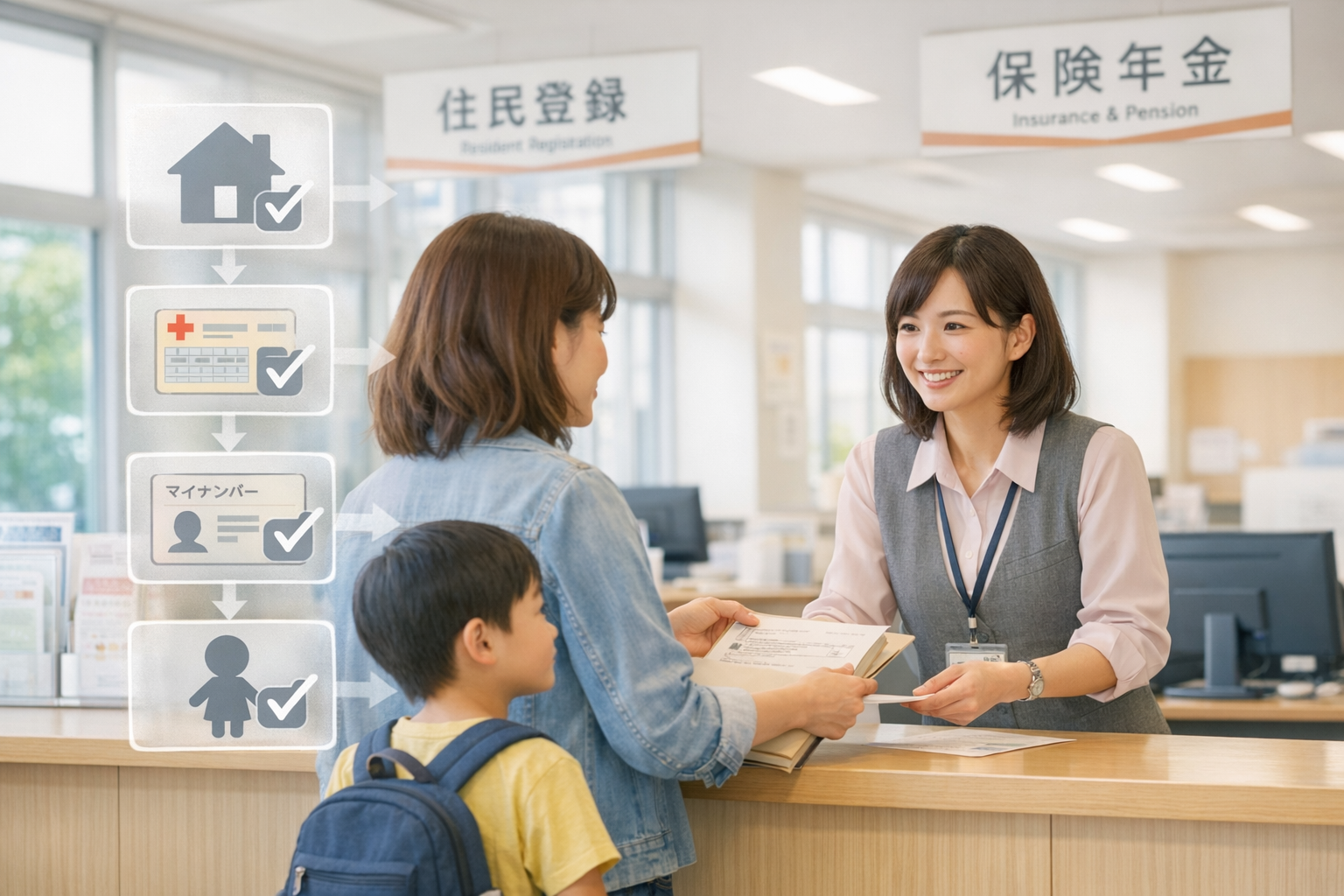
When you move to Japan, registering your address at the local city hall is one of the first steps you must complete. This process is mandatory and must be done within 14 days of moving into your new residence. Failure to comply can result in fines of up to ¥50,000 ($340) under the Basic Resident Registration Act, or up to ¥200,000 ($1,360) under the Immigration Control Act for foreign nationals. Here’s a quick overview of what you need to know:
- Documents to Bring: Residence Card, passport, proof of address (like a rental contract), and, if applicable, family-related documents (e.g., marriage and birth certificates with Japanese translations).
- What to Do: Register your address, enroll in National Health Insurance, and apply for your My Number Card. Families may also need to visit the Children’s Division for child allowances, healthcare subsidies, and school/vaccination registrations.
- Deadlines: Address registration and health insurance enrollment must be completed within 14 days of moving in. Failure to do so can result in fines of up to ¥200,000 for foreign nationals, and remaining unregistered for 90 days or more without a valid reason may result in revocation of your residence status.
- Multilingual Support: Many city halls offer assistance in English and other languages, either in person or via the Ministry of Internal Affairs‘ multilingual call center.
Planning ahead and bringing the correct documents will save time and help you settle into your new life smoothly. Let’s dive into the details of these processes.
Important Procedures after Arrival in Japan: 1. Procedures at the City Hall [rev.]
sbb-itb-15a157d
What to Do Before Visiting City Hall
Before heading to city hall, get your paperwork in order to avoid unnecessary delays. Knowing exactly what to bring and where to go can make the registration process much smoother.
Documents You Need to Bring
You’ll need your Residence Card (Zairyu card) and passport. If you didn’t receive your Residence Card at the airport, bring your passport with the landing permission stamp instead. Additionally, have documentation to prove your new address, such as a formal rental contract or an official letter from your employer or landlord with a seal (hanko).
For families, it’s essential to provide official documents verifying relationships, such as marriage certificates for spouses or birth certificates for children. These must include professional Japanese translations. If you’re moving from another city in Japan, don’t forget your Moving-out Certificate (Tenshutsu Shomeisho) from your previous city hall. You may also want to request copies of your Certificate of Residence (Juminhyo), as these are often needed for setting up bank accounts or mobile phone contracts.
Registration Deadlines You Must Follow
You must register within 14 days of moving in. Failure to comply can result in fines of up to ¥50,000 ($340) under the Basic Resident Registration Act, or up to ¥200,000 ($1,360) under the Immigration Control Act for foreign nationals. If registration isn’t completed within 90 days and no valid reason is provided, your resident status could be revoked. Even if you’re only changing addresses within the same municipality, you still need to notify the office within 14 days.
How to Find Your Local Municipal Office
Once you’ve confirmed your registration deadline, figure out which municipal office to visit. Your destination depends on your municipality type: Shiyakusho (City Hall), Kuyakusho (Ward Office), Machiyakuba (Town Hall), or Murayakuba (Village Office). If you live in a large city like Yokohama, you’ll need to go to the specific ward office for your residential area, not the central city hall. To find the right location, search for the name of your ward followed by “Ward Office.”
Most municipal websites offer English sections or automated translation tools. Check the “Foreign Resident” section for details like office locations, hours, and counter numbers. Typical office hours are 8:30 AM to 5:15 PM, Monday through Friday, though some larger offices may provide limited services on Saturdays. Before visiting, it’s helpful to know the exact floor and counter you’ll need, such as the Family Registry Division, Citizen Services Division, or Residents Support Section, to save time navigating the building.
How to Register Your Address
Registering your address, or Jumin Toroku, is the first and most important step when settling into a new city in Japan. This process creates your Resident Record, which is essential for accessing services like National Health Insurance, the pension system, and your My Number. Without completing this step, you won’t be able to access healthcare, open a bank account, or enroll in schools.
The process itself is fairly simple. After submitting the necessary documents, the municipal officer will confirm your residency status with the Ministry of Justice. Once verified, they’ll update the back of your Residence Card with your new address. This updated card becomes your main form of identification in Japan, and the address change is mandatory.
When you register your address, it also triggers the issuance of your 12-digit Individual Number (My Number), which is used for taxes and social security. You’ll receive a notification with this number by mail at your registered address within 2 to 3 weeks. The registration itself is free, but if you need proof of address, you can request a Certificate of Residence (Juminhyo) for a small fee, usually between ¥200 and ¥400 ($1.35 to $2.70). Once your address is officially registered, you can move on to filing your moving-in notification.
Filing Your Moving-In Notification
To file your moving-in notification, visit the Citizen Services Division or Residents Support Section at your municipal office and ask for the Moving-In Notification form (Ten’nyu-todoke). If you’re coming from another city in Japan, you’ll need to use the Change of Residence form (Jumin-idou-todoke) instead.
The form will ask for details such as your name, date of birth, previous address, new address, and the date you moved in. You can only submit this form after you’ve moved in. If you’re registering family members, you’ll need to indicate their relationship to you on the form and provide documents that link your household records.
Once the form is filled out, submit it along with your Residence Card and passport. The clerk will review your information and update your Residence Card with your new address. Keep in mind that this process must be done in person unless your ward office allows an alternative.
Required Documents for Address Registration
Here’s what you’ll need to bring for address registration:
- Residence Card: If you don’t have one, you can use your passport with the landing stamp.
- Moving-Out Certificate (Tenshutsu Shomeisho) if you’re moving from another city in Japan. This document should be obtained from your previous municipal office.
- For families moving together, provide family-related documents with certified Japanese translations.
- Some offices may also ask for your housing contract or lease agreement to confirm your move-in date and address.
Having all your documents in order will ensure the process goes smoothly and without delays.
Getting Your My Number Card
After registering your address, you’ll receive a notification letter with your unique 12-digit My Number within three weeks. Keep in mind, this letter is just a notification – you’ll need to apply separately to get your My Number Card. This card acts as your official photo ID and provides access to various government services.
The My Number Card plays a crucial role in daily life in Japan. Employers often request it for tax and social insurance purposes. It’s also commonly required for opening bank accounts and filing tax returns online through e-Tax. On top of that, the card lets you print official documents, like Resident Records, at convenience store kiosks – saving you a trip to city hall. Here’s a breakdown of how to apply and what you can do with the card.
How to Apply for Your My Number Card
You have three ways to apply:
- Online Application: Use the QR code or enter the 23-digit Application ID from your notification letter on the official website. Then, upload a recent photo of yourself.
- By Mail: Attach a recent photo to the application form and send it to the Japan Agency for Local Authority Information Systems (J-LIS).
- In Person: Some municipal offices offer application support at their Family Registry or My Number counters.
Once you’ve applied, you’ll get an issuance notice within a month. To pick up your card, bring the issuance notice, your Residence Card, and the original notification letter to your municipal office. You’ll also need to set four PINs: a 6–16 character alphanumeric password for digital signatures and three 4-digit numeric codes.
Important Tip: If you’re in the process of extending your visa, wait until it’s approved before applying. Otherwise, your card might expire prematurely.
What You Can Do with Your My Number Card
After receiving your card, you’ll find it simplifies many administrative tasks. Acting as your official photo ID, the card also integrates your social security, taxation, and health insurance details. This often eliminates the need to submit extra documents, like residence certificates, during official procedures.
For healthcare, you can register the card as your health insurance card through MynaPortal or at a Seven Bank ATM. Once registered, you can use it at hospitals and pharmacies with card readers – though you’ll still pay the standard 30% co-payment for medical services. For taxes, the card allows you to file income tax returns electronically using e-Tax. If you relocate within Japan, you can even submit your move-out notification online via MynaPortal’s “One-Stop Moving Service”, cutting down on city hall visits.
Take care of your card – it has an embedded IC chip that’s sensitive to strong magnets. Avoid placing it near magnets, like those on smartphone cases or speakers. Also, municipal offices can get crowded, especially on Monday mornings from 10:00 a.m. to 12:00 p.m., so try to visit during quieter times.
Signing Up for National Health Insurance
In Japan, anyone staying for more than three months is required to join a public health insurance plan. If your employer doesn’t offer health insurance, you’ll need to sign up for National Health Insurance (Kokumin Kenko Hoken) at your local city hall. This system covers 70% of your medical expenses, leaving you responsible for the remaining 30% when you visit hospitals, clinics, or pharmacies.
You must enroll within 14 days of becoming eligible – whether you’ve just arrived in Japan, moved to a new city, or changed jobs – to avoid penalties. Missing this deadline could mean paying up to two years of back premiums and may even impact your visa renewal. The good news? You can handle this enrollment at the same time you register your address at city hall, saving yourself an extra trip. Here’s how to get it done.
How to Enroll in Health Insurance
Head to the National Health Insurance Division at your local municipal office with your Residence Card and My Number notification letter or card. If you’ve recently left a job, bring a Certificate of Loss of Qualification for Health Insurance from your previous employer. For families, you’ll also need documents proving relationships – like marriage or birth certificates – translated into Japanese.
Your premiums are based on last year’s income in Japan, the size of your household, and your municipality’s specific rates. For international students, the monthly cost is typically around ¥2,000 during the first year, as they usually have no prior income in Japan. If your income is low, ask the staff about potential premium reductions. Residents aged 40–65 will also see an additional charge for long-term nursing care. Payment slips are issued monthly, and you can pay at convenience stores, banks, or set up automatic transfers.
Health Insurance Options for Employed vs. Unemployed Residents
Your employment situation determines which health insurance system you’ll use. Here’s a quick comparison:
| Feature | Employer-Sponsored Insurance (Kenko Hoken) | National Health Insurance (Kokumin Kenko Hoken) |
|---|---|---|
| Eligibility | Full-time employees | Self-employed, unemployed, students, retirees |
| How You Enroll | Employer handles enrollment within 5 days of hiring | Apply in person at your local city hall |
| Premium Payment | Deducted automatically from your salary | Paid via monthly bills at convenience stores or through bank transfer |
| Cost Sharing | Employer and employee split the cost | Entire premium paid by you, based on income |
| Medical Coverage | Covers 70% of costs (30% co-payment) | Covers 70% of costs (30% co-payment) |
Both systems offer the same 70% medical cost coverage, but their enrollment processes and payment methods differ. If you lose or change jobs, you’ll need to switch to National Health Insurance. Don’t forget to bring the certificate of loss from your former employer when visiting city hall to make the transition smooth.
School and Childcare Registration for Families with Kids
Once you’ve completed your address registration, the next step for families is handling school and childcare enrollment. To enroll your children in school or childcare, head to the municipal office. Foreign children can attend public elementary and junior high schools as long as you provide the necessary documents. It’s best to visit the Children’s Division or the Board of Education at your municipal office promptly after completing your resident registration.
Make sure to have all the required paperwork ready. You’ll need your Residence Card, passport, and a Certificate of Residence (Juminhyo) that lists your child’s name, date of birth, and your relationship to them. If you have foreign documents, such as birth certificates, ensure they include a Japanese translation. For younger children, you’ll also need to pick up a Mother and Child Health Handbook (Boshi Techo) and vaccination records from the Health Division. Some municipalities also offer subsidies to lower hospital co-payments.
Enrolling Your Child in Public School
Public elementary schools (shogakko) and junior high schools (chugakko) provide free tuition and textbooks. Elementary school starts in April after a child turns six, but foreign nationals can complete enrollment at any time during the year. Once your paperwork is submitted, the municipal office will assign your child to a school in your district based on your registered address.
While tuition and textbooks are free, parents are responsible for school supplies, lunch fees, and other minor expenses. If you’re struggling financially, ask about School Expense Grants, which can help cover these costs. For children needing language assistance, download the Ministry of Education’s “Guidebook for Starting School.” This resource is available in several languages, including English, Chinese, Filipino, Korean, Portuguese, Spanish, and Vietnamese. You can also check if interpreter services are available on specific days.
Applying for Nursery or Kindergarten
Planning ahead is crucial for childcare enrollment. Start the process by visiting the Children’s Division at city hall, and bring the same documents you used for address registration, along with your health insurance card. Public childcare facilities often have waiting lists – particularly in urban areas – so it’s wise to apply early. Private facilities may have shorter wait times but typically charge higher fees.
While you’re at city hall, don’t forget to apply for the Child Allowance (Jido Teate) within 15 days of your move or your child’s birth to avoid delays in receiving payments. This monthly subsidy helps offset childcare costs and is available to most families with children. The Children’s Division can assist with both your childcare application and allowance paperwork in a single visit.
Other Registrations and Services You May Need
Foreign nationals are required to update their address within 14 days to avoid fines of up to ¥50,000 ($340) under the Basic Resident Registration Act, or up to ¥200,000 ($1,360) under the Immigration Control Act. If you don’t register within 90 days and don’t have a valid reason, you could even lose your resident status. Keeping your records updated is just as important as your initial registration, so don’t overlook these ongoing responsibilities.
Updating City Hall When Your Information Changes
When you move between cities, you’ll need to notify city hall. Start by submitting a moving-out notification (tenshutsu todoke) to get a certificate, then present it along with your moving-in notification at the city hall in your new location. If you’re moving within the same city, you’ll only need to file a change of address notification (tenkyo todoke).
Once your address is updated, the city hall will modify your Residence Card and adjust your My Number Card to reflect the change. If you’re enrolled in National Health Insurance, you’ll also need to update your insurance. Moving to a new city typically means withdrawing from your old city’s plan and enrolling in the new one. While the registration process itself is free, getting copies of your updated Resident Record (Juminhyo) usually costs ¥200–¥400 per copy (around $1.35–$2.70).
It’s also important to inform city hall of any changes in your family status. For instance, a birth must be registered within 14 days, while marriage and divorce registrations don’t have strict deadlines but should be done promptly. If you’re registering a marriage, you’ll generally need a Certificate of Legal Capacity to Contract Marriage from your embassy, your passport, and two adult witnesses to sign the Notification of Marriage (Kon-in Todoke). Any foreign documents must be accompanied by Japanese translations. Keep in mind that updating your status at city hall doesn’t automatically notify your home country, so check with your embassy to see if additional steps are required.
Once your records are updated, you’ll be ready to access essential services, such as opening a bank account.
Opening a Personal Bank Account
Your updated city hall registration is key to setting up services like a bank account. Most banks will ask to see your updated Residence Card as proof of your resident registration. They may also request a Certificate of Residence (Juminhyo) to confirm your identity, address, and household details. Additionally, your 12-digit My Number might be needed for tax purposes or international transfers. To avoid delays, consider requesting multiple copies of your Juminhyo during your initial registration, as they’re often required for other services like signing up for a mobile phone plan or renting an apartment.
Conclusion
Registering within 14 days helps you avoid fines of up to ¥50,000 ($340) under the Basic Resident Registration Act, or up to ¥200,000 ($1,360) under the Immigration Control Act for foreign nationals. The process usually takes 30–45 minutes if you have the necessary documents ready. Your Passport and Residence Card are essential for nearly every step. If you’re registering family members, make sure to bring marriage and birth certificates, along with official Japanese translations, to avoid delays. These preparations can make your interactions with municipal services much easier.
Once these registrations are handled, tackling other administrative tasks becomes less stressful. For more complicated procedures, NTI can provide valuable assistance. They offer document translation services, help you meet registration deadlines, and guide you through navigating different municipal departments – whether it’s the Foreign Resident counter or the Children’s Division.
Municipal offices are typically open on weekdays from 8:30 a.m. to 5:00 p.m. (or until 5:15 p.m. in some locations), so plan your visit accordingly. If you’re unable to visit during these hours, you can appoint a proxy by providing a letter of attorney and your original identification. After completing your initial registration, make sure to update your information promptly if you move, experience changes in family status, or need to renew any documents.
With the right preparation and support from NTI, you can handle these tasks efficiently and settle into life in Japan with ease.
FAQs
What should I do if I’m unable to register my address within 14 days of moving to Japan?
If you didn’t register your address within 14 days of arriving in Japan, don’t panic – but make it a priority to handle it as soon as possible. Address registration isn’t just a formality – it’s a legal requirement, and delays could affect your ability to access critical services like health insurance, pension enrollment, and other official paperwork.
When you go to the city hall, explain your situation politely. In most cases, they’ll still process your registration, though you might need to explain why it was delayed. Make sure to bring your residence card, passport, and any other relevant documents. If you’re not confident in your Japanese, consider bringing along a Japanese-speaking friend or using a translation app to make communication smoother.
How can I apply for a My Number Card if I don’t speak Japanese?
If you don’t speak Japanese, don’t worry – applying for your My Number Card in Japan is still quite doable. The easiest way is to apply by mail. After registering as a resident at your local city hall, you’ll get a notification postcard in about 2–3 weeks. This postcard will include a QR code that lets you apply online, and the online system even offers an English-language option.
If you prefer, you can fill out the application form that comes with the postcard and mail it back. While the form itself is in Japanese, you can ask for help at your city hall or use a translation app to navigate it. These options make it possible to complete the process even without knowing Japanese.
What happens if I don’t sign up for National Health Insurance right away?
Failing to sign up for National Health Insurance (NHI) on time can cause several problems. For starters, you might incur penalties for registering late, and any unpaid premiums will still be charged from the date you were supposed to join. On top of that, delaying enrollment could leave you without coverage, meaning you’d have to pay the full cost of medical care out of pocket until your insurance kicks in.
To steer clear of these issues, make it a point to register for NHI right after completing your resident registration at your local city hall. This not only keeps you in line with Japanese law but also ensures you’ll have access to affordable healthcare when you need it.