Finding an apartment in Japan as a foreigner can be challenging. High upfront costs, language barriers, and strict landlord requirements often make the process overwhelming. Here’s what you need to know:
- Upfront Costs: Expect to pay 4–6 months’ rent upfront, including key money (non-refundable), security deposit, agency fees, and guarantor charges. For example, if rent is ¥70,000 ($483), initial costs can reach ¥420,000 ($2,897).
- Guarantor System: Most landlords require a guarantor or guarantor company. Fees can range from 30–100% of one month’s rent.
- Required Documents: Passport, residence card, visa, employment certificate, and proof of income are essential. A Japanese phone number and emergency contact are also needed.
- Language Barriers: Contracts and negotiations are usually in Japanese. Consider using real estate agents offering English support.
- Alternative Options: Share houses or UR rentals may be easier for foreigners, with lower upfront costs and fewer requirements.
Preparation is key. Save enough for upfront costs, gather all necessary documents, and work with agencies experienced in assisting foreigners. Understanding the process will help you secure housing in Japan with fewer hurdles.
How to rent a house or apartment in Japan (Everything you need to know)
How Japan’s Rental System Works
Renting a place in Japan is a bit different from the process in the United States. It involves three key players: the landlord, a management company, and a guarantor company. Each of these parties has its own criteria for screening applicants.
Guarantors and Screening Requirements
If you’re a foreigner renting in Japan, you’ll almost always need a guarantor company (保証会社, hoshō gaisha). These companies act as a safety net for landlords by covering missed rent payments or repair costs on your behalf.
Guarantor companies will carefully review several factors, including your income, employment status, visa validity (you’ll usually need at least six months remaining), and a local emergency contact. Without their approval, most landlords won’t move forward with your application.
Now, let’s take a closer look at the costs you’ll face when moving in.
Move-In Costs and Fees
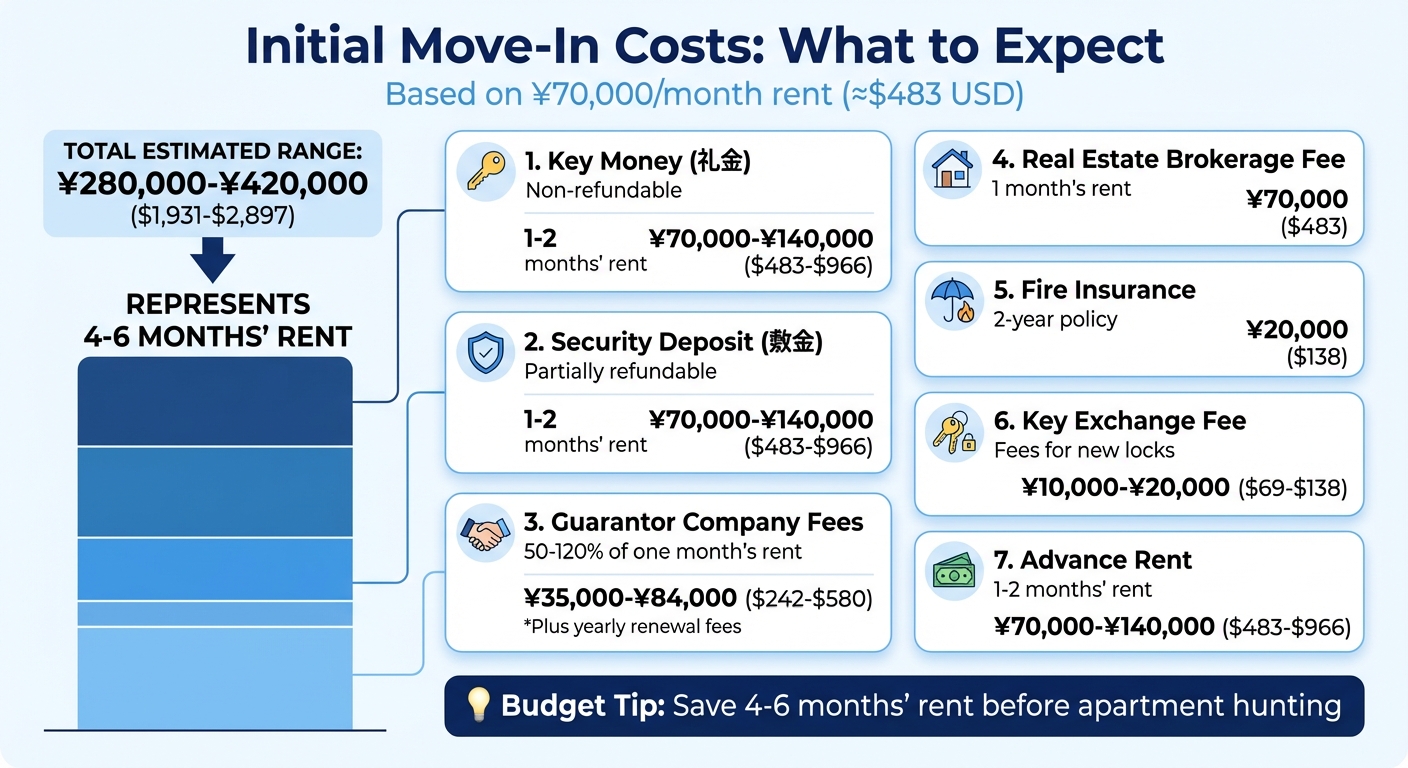
Be prepared for significant upfront costs – often four to six months’ worth of rent in advance. For example, if your rent is ¥70,000 per month (about $483), your initial expenses could range from ¥280,000 to ¥420,000 (approximately $1,931 to $2,897).
Here’s a breakdown of common move-in fees:
- Key Money (礼金, reikin): A non-refundable payment to the landlord, usually one to two months’ rent (¥70,000–¥140,000 or $483–$966). This custom dates back to post–World War II housing shortages and is rare outside Japan.
- Security Deposit (敷金, shiki-kin): Typically one to two months’ rent. While partially refundable, deductions are often made for cleaning and repairs.
- Guarantor Company Fees: These range from 50% to 120% of one month’s rent (about ¥35,000–¥84,000 or $242–$580), with additional yearly renewal fees.
- Real Estate Brokerage Fee: Usually equal to one month’s rent (around ¥70,000 or $483).
- Fire Insurance: Costs about ¥20,000 for a two-year policy (roughly $138).
- Key Exchange Fee: This fee ranges from ¥10,000 to ¥20,000 (approximately $69–$138).
- Advance Rent: Many landlords require one to two months’ rent upfront before you move in.
Understanding tenant expectations is another important part of the process.
Tenant Behavior and Expectations
Japanese landlords place a high value on how tenants behave and whether they can adapt to local norms. They expect tenants to take good care of the property and to handle any problems promptly. Rejections may sometimes occur due to communication barriers or a lack of familiarity with Japanese customs. Showing that you understand and respect these expectations can go a long way in making a positive impression during your application process.
Documents and Preparation Before Arrival
Getting your paperwork in order ahead of time can make the rental process in Japan much smoother. Think of this as laying the groundwork for a successful rental application.
Required Legal Documents
Start by ensuring your passport is valid with plenty of time left before expiration. After arriving in Japan, you’ll receive a residence card (zairyū card), which serves as your main ID for renting. Landlords will also want to see your visa to confirm your legal status and its remaining validity. If you’re a student, bring your student ID and, if possible, any admission letters. If you’re employed, an official employment certificate from your Japanese employer will be essential.
You might also need a personal seal (hanko or inkan) for signing contracts, though some landlords may accept a signature instead. Once you register your address at the local ward office, you’ll receive a Certificate of Residence (住民票), which is required to finalize your lease agreement.
Budget and Income Verification
Plan your budget carefully – experts recommend keeping your rent between 25–30% of your monthly income. Be aware that initial move-in costs can total four to six months’ rent, so saving in advance is crucial. To prove you can afford the rent, prepare documents like payslips, income tax slips, and your certification of employment. For students, a student ID often works as proof of status. During the screening process, landlords or guarantor companies will review your occupation, income level, and visa expiration date to ensure you’re financially stable.
Local Phone Number and Emergency Contact
A Japanese phone number is almost always required when applying for an apartment. If your phone is unlocked, you can buy a prepaid SIM card at the airport or at major electronics stores like Bic Camera, Yodobashi Camera, or Yamada Denki. Providers like Mobal offer SIM cards that provide a Japanese phone number on the spot, which can be used temporarily for your application until you’re fully settled.
You’ll also need to provide an emergency contact, especially if working with a guarantor company. This person should be reliable and able to answer questions about you during the screening process. With all your documents and preparations in place, you’ll be ready to tackle the next step: the application and screening process.
The Application and Approval Process
Once you have your documents ready, it’s time to begin your application. A little preparation now can save you from unnecessary delays later.
Working with Real Estate Agents
In Japan, real estate agents have access to a shared database of listings, which means that no matter which agency you choose, you’ll have access to properties across the city. To simplify your search, start with platforms that offer English support and a straightforward process. If you visit a local fudōsan (real estate office), it’s a good idea to ask upfront if they can assist in a foreign language.
When reaching out to an agent, be specific about your needs. Share details like your budget, preferred neighborhoods, commute preferences, room size, building type, and whether you need the property furnished. You’ll also need to provide key personal information, such as your visa type, income, and employment details. Agents typically ask for your passport, residence card, employment contract, and a local emergency contact. Keep in mind that apartments friendly to foreigners tend to rent out quickly, so be ready to act fast when you find a good match. Always schedule an in-person tour (naiken) – spaces around 15 square meters (about 161 square feet) can feel even smaller in person.
Once you’ve applied, the next step is the screening process.
What Happens During Screening
After submitting your application, landlords and guarantor companies will begin reviewing your eligibility. They’ll assess factors like your income stability, visa type, job contract, and guarantor details. This usually involves verifying documents such as your employment certificate and income tax slip. If you’re using a guarantor company (a common practice for foreigners in Japan), they will also conduct their own checks, including reviewing your financial situation and contacting your local emergency contact. Having all your documentation in order before applying makes this process much smoother. Keep in mind that screening can take anywhere from one to two weeks – or even longer.
Being aware of these steps can help you avoid potential setbacks, which we’ll explore next.
Why Applications Get Rejected and How to Prevent It
Application rejections happen, but understanding the common reasons can help you avoid them. One common issue is related to your guarantor – either not having one or encountering problems during the guarantor company’s screening process. Other frequent reasons include unstable or insufficient income, a visa nearing its expiration date, or missing essential documents like your residence card or employment certificate. Having a strong guarantor is one of the best ways to strengthen your application.
To improve your chances, secure a guarantor early. This could be a Japanese national with a stable income or a guarantor company. Make sure your income is steady and well-documented, and ensure your visa has plenty of validity left. If guarantor requirements become a roadblock, ask your agent to look for properties with more flexible screening criteria. Finally, try to avoid applying during peak moving seasons like April and October, as landlords tend to be more selective and less accommodating during these times.
2026 Approval Checklist: Property Search to Move-In
Use this checklist to guide you seamlessly from searching for a property to settling into your new home.
Choosing Properties and Locations
Start by defining your rental needs. A good rule of thumb is to keep your rent below one-third of your monthly income and plan to have 4–6 months’ rent ready upfront. For instance, if the rent is ¥70,000 (about $470) per month, you’ll likely need around ¥345,000 (approximately $2,320) to cover costs like the security deposit, key money, broker fees, advance rent, fire insurance, key replacement, and guarantee fees.
Location plays a huge role in pricing. Renting outside Tokyo’s 23 wards is often much cheaper. A one-bedroom apartment in central Tokyo averages around ¥146,666 (roughly $985), while in Fukuoka, it’s about ¥64,593 (around $434). Think about your daily commute, access to train lines, supermarkets, and hospitals when choosing a location. Apartments in Japan are categorized by layout classifications, such as 1R (a single room with a kitchenette), 1K (a room with a separate kitchen), 1DK (a room with a dining-kitchen area), and 1LDK (a room with a living-dining-kitchen area). In Tokyo, the average one-bedroom apartment is about 40 square meters (430 square feet).
“The ‘Trade-off Principle’ is essential when renting in Tokyo. Due to the city’s dense nature and high demand for housing in Japan, it’s nearly impossible to find a property that satisfies all your criteria at a reasonable price.” – E-Housing.jp
When viewing properties, check which amenities are included. Many Japanese apartments don’t come with appliances like refrigerators or washing machines, so factor in those costs. Test phone reception, assess natural light, and walk around the neighborhood to gauge noise levels and convenience. Also, avoid peak moving seasons – January to March and September to October – when demand and prices are higher, and landlords tend to screen tenants more strictly. Moving between June and August often gives you better negotiating leverage.
Once you’ve found the right property, it’s time to proceed with the lease review and signing.
Reviewing and Signing Your Lease
Carefully review the “explanation of important matters” provided by the agency. Most leases run for two years, and renewal fees typically equal one month’s rent. Pay attention to cancellation policies, which often require one to two months’ notice, and any rules about noise, pets, or renovations. Also, understand the restoration requirements for when you eventually move out.
You might be able to negotiate waivers for certain fees, like key money, especially if you’re renting outside peak moving seasons. Confirm whether your security deposit is refundable or considered a non-refundable fee. After signing and making the necessary payments, schedule your move-in and inspect the apartment thoroughly. Check all appliances, outlets, plumbing, walls, floors, and windows for damage, and document any issues with photos. Submitting a move-in checklist (genjo kakuninhyo) to your landlord within two weeks can help protect you from being charged for pre-existing damage.
Once your lease is finalized, arrange for utilities – electricity, gas, and water – right away. Don’t forget to budget around ¥4,000 (approximately $27) annually for liability insurance. Lastly, register your new address at the local ward office within 14 days of moving in.
If needed, you can explore alternative housing solutions.
Alternative Housing Options
If renting a traditional apartment proves difficult, consider alternatives like share houses or Urban Renaissance Agency (UR) rentals. Share houses typically involve minimal upfront costs – around ¥30,000 (about $200) – and often don’t require a security deposit or key money. Monthly rent ranges from ¥24,800 to ¥40,000 (roughly $167–$270), with a common fee of about ¥15,000 (approximately $100) covering utilities. These setups are great for shorter stays or when you need a furnished place while searching for something permanent.
UR rentals, on the other hand, don’t require a guarantor, key money, or agent fees. However, they often require proof of higher income, with monthly earnings needing to be at least four times the rent. For very short-term stays, you might also look into monthly or weekly apartments. While these offer flexibility, their higher monthly rates can make them less cost-effective for longer stays.
Conclusion
Renting an apartment in Japan as a foreigner requires preparation, realistic expectations, and a good grasp of local practices. The process can be challenging – whether it’s finding a guarantor, gathering the necessary documents, or dealing with steep upfront costs and landlord screenings. In fact, surveys indicate that 40% of foreigners experience rejection solely based on nationality, a practice that remains legal under Japanese law.
Success in Japan’s rental market often hinges on careful planning. Working with specialist agents who speak English can make a significant difference. These agents not only simplify the application process but also help you understand contract terms and handle utility setups. Studies suggest that their expertise can save both time and money.
Language barriers are still a hurdle, but companies like Xross House are stepping in to make the process smoother. They offer multilingual support in 10 languages – including Japanese, English, Korean, and Chinese – while keeping initial costs low. Their web-only contracts even allow overseas residents to sign leases before arriving in Japan.
With professional assistance and thorough preparation, you can approach the rental process with confidence. The screening phase typically takes 2 days to 1 week, so patience is key. Making a strong first impression during property viewings, having all your documents ready, and choosing experienced agents will go a long way in avoiding common pitfalls. By staying organized and adaptable, you’ll be well-equipped to navigate Japan’s rental market and secure a home that meets your needs.
FAQs
What is Japan’s guarantor system for renting apartments, and why is it required?
In Japan, renting an apartment often comes with the requirement of a guarantor – someone who agrees to take on financial responsibility if the tenant fails to pay rent or cover other expenses. This system is primarily in place to give landlords extra peace of mind, especially when renting to individuals who lack a Japanese credit history, such as foreigners.
For many non-Japanese residents, finding a guarantor can be a hurdle since it typically needs to be someone living in Japan, like a family member or a close friend. To solve this issue, many renters turn to professional guarantor companies. These companies step in as substitutes for personal guarantors, charging a fee for their services – usually around the equivalent of one month’s rent or a percentage of it.
The guarantor system plays a key role in reassuring landlords about a tenant’s financial reliability. Without it, renting an apartment in Japan can be a real challenge, even if you have a steady income or a valid visa. Being aware of this requirement and planning ahead can make the entire rental process much easier.
How can I handle language barriers when renting an apartment in Japan as a foreigner?
Navigating language barriers while renting in Japan can feel daunting, but a bit of preparation can go a long way. Familiarize yourself with essential Japanese rental terms such as “deposit” (敷金 shikikin), “key money” (礼金 reikin), “contract” (契約 keiyaku), and “move-in date” (入居日 nyūkyo-bi). Knowing these terms can make it easier to understand listings, contracts, and other critical details during your search.
If Japanese isn’t your strong suit, working with a bilingual real estate agent can be a game-changer. Many agencies in Japan have English-speaking staff who can walk you through the process, explain things like the guarantor system, and even assist with negotiations. Alternatively, you could enlist the help of a trusted friend for translation. To avoid confusion during property visits, consider preparing a list of questions in both English and Japanese or using a reliable translation app. These steps can help ensure clear communication and minimize misunderstandings.
What are some alternative housing options for foreigners renting in Japan?
If you’re a foreigner in Japan and searching for housing beyond the usual long-term apartment rentals, there are a few alternatives worth exploring. For instance, share houses provide a private room while offering shared spaces like kitchens and living areas, making them a great choice for those who enjoy a community vibe. Guesthouses cater to short-term stays and typically include basic amenities, perfect for travelers or those needing temporary lodging.
Another option is corporate housing, often arranged by employers for expat workers, offering convenience and a ready-to-move-in setup. For students, university dormitories are a practical and often affordable choice.
Each of these options comes with its own advantages, such as lower upfront costs or flexible lease terms. To find the best fit, take the time to review the terms and conditions of each type of accommodation based on your specific needs.


