Japan’s franchise market is booming, with sales reaching ¥26.99 trillion ($189.25 billion) in 2022. For foreign entrepreneurs, franchising offers not just a business opportunity but also a potential pathway to residency via the Business Manager Visa. However, updated Business Manager visa rules have made the process stricter, requiring ¥30 million in capital, hiring one full-time employee, and Japanese proficiency (JLPT N2 or equivalent).
Here’s what you need to know:
- Visa Requirements: Meet higher capital, employment, and language standards. Maintain active business involvement, tax compliance, and proper licensing.
- Franchise Setup: Choose between Kabushiki Kaisha (KK) or Godo Kaisha (GK) for your business structure. Secure a physical office and necessary permits.
- Cultural Insights: Understand workplace norms like nemawashi, horenso, and omotenashi to manage effectively and deliver top-tier service.
- Support Services: Firms like Nippon Bridge can assist with incorporation, visa compliance, franchise agreements, and relocation.
Navigating these requirements and cultural nuances is essential for success in Japan’s competitive market. This guide breaks down everything you need to start and operate a franchise in Japan while meeting the updated visa rules.
Big Changes to Japan’s Business Manager Visa | 2025 Updates
Business Manager Visa Requirements
The Business Manager Visa offers foreign entrepreneurs a pathway to establish and operate a franchise in Japan while securing legal residency. However, obtaining and renewing this visa comes with specific requirements. Authorities now place greater emphasis on active business operations – passive ownership or delegating all management tasks won’t meet the criteria.
Eligibility Criteria
If you’re looking to qualify for a Business Manager Visa as a franchise owner, you’ll need to meet several important requirements:
- Capital Investment: A minimum of ¥30 million (around $197,000 to $203,000) is required, a significant jump from the previous ¥5 million threshold. This amount must be registered as company capital, not held in a personal account.
- Employment: Your business must employ at least one full-time staff member who has Japanese residency status. This employee must also be enrolled in social insurance and receive a regular salary.
- Language Proficiency: Either the applicant or the full-time employee must meet the language requirement. This can be satisfied by achieving JLPT N2, CEFR B2, or scoring 400+ on the BJT Business Japanese Proficiency Test. Other options include having 20+ years of residence in Japan or holding a degree from a Japanese university.
- Experience or Education: Applicants must demonstrate three years of business management experience or hold a Master’s degree (or higher) in a relevant field.
- Certified Business Plan: A professional, such as an SME Management Consultant, CPA, or Tax Accountant, must certify your business plan. Basic, uncertified plans will not be accepted.
- Office Space: A dedicated commercial office is mandatory. Home or virtual offices are no longer permitted. The office must have a separate entrance for business use and meet franchise-specific operational needs. The lease agreement must explicitly allow commercial use.
- Local Collaboration: If you’re applying from overseas, you’ll need a trusted local partner in Japan. This collaborator can help manage investment funds, register your company, and secure office leases before your arrival.
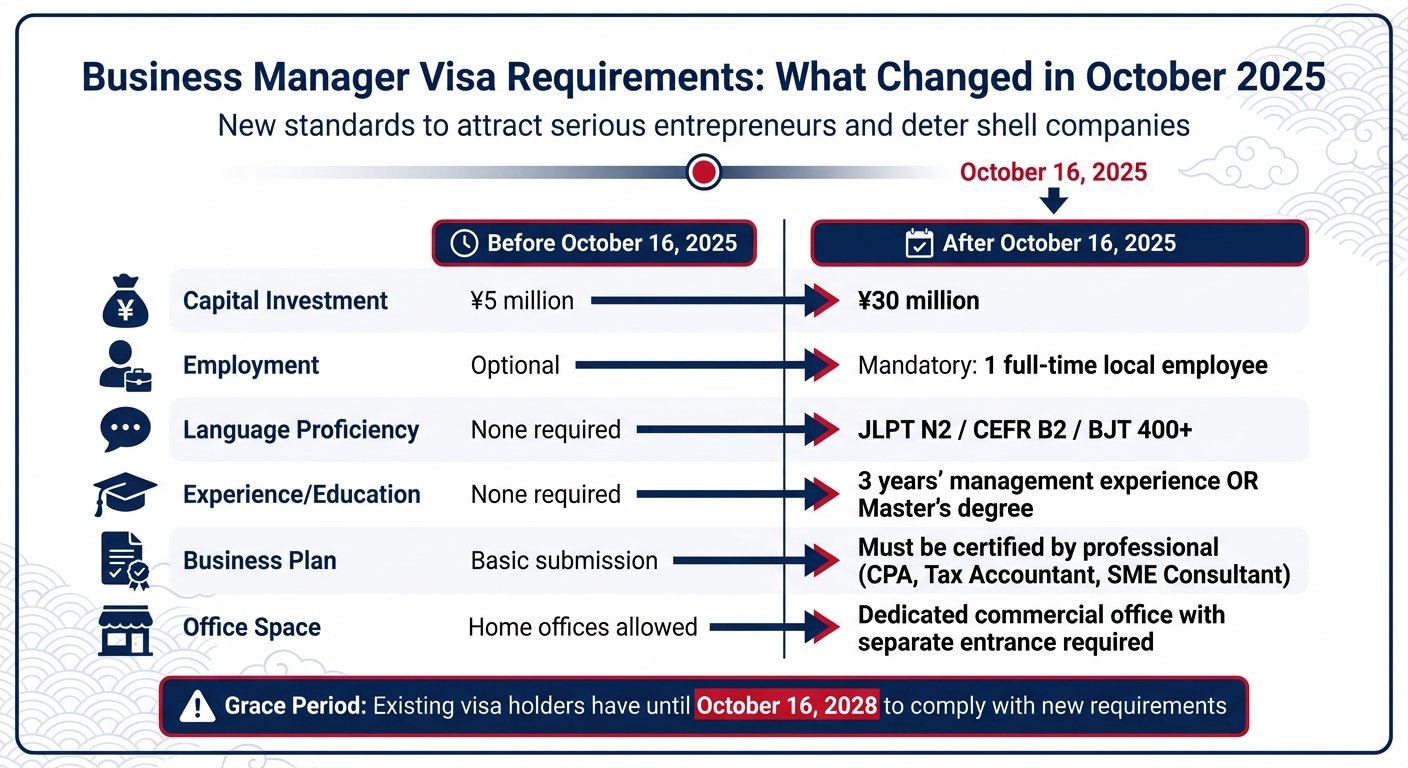
The table below highlights the changes made to visa requirements as of October 2025.
Visa Requirement Changes: Before and After October 2025
To attract serious entrepreneurs and deter shell companies, Japan revised its standards on October 16, 2025. Here’s a comparison of the old and new requirements:
| Category | Before October 16, 2025 | After October 16, 2025 |
|---|---|---|
| Capital Requirement | ¥5 million | ¥30 million |
| Employment | Optional | Mandatory (1 full-time local employee) |
| Language Skills | None | JLPT N2 / CEFR B2 |
| Experience/Degree | None | 3 years’ experience or Master’s degree |
| Business Plan | Basic submission | Certified by a professional |
| Office Space | Home offices allowed | Dedicated commercial office required |
Visa holders under the old rules have until October 16, 2028, to comply with the updated standards. During this three-year grace period, you’ll need to raise your capital to ¥30 million and hire the required full-time employee. Failing to meet these new benchmarks could result in denial of Permanent Residency or Highly Skilled Professional status applications.
Maintaining Compliance
Meeting the initial criteria is just the first step. To keep your Business Manager Visa, you must maintain active involvement in your business and adhere to strict operational standards. Renewal applications are more rigorous than initial ones, with authorities closely examining your business’s performance and legal compliance.
Key areas of compliance include:
- Tax and Social Insurance: Authorities will verify that all taxes (national and local) and social insurance payments are up to date. Missing or late payments can lead to visa renewal denial.
- Permits and Licenses: Ensure all necessary permits for your franchise are valid and submitted during the renewal process. For example, food service franchises must provide current food handling licenses.
- Office Operations: Your physical office must remain functional throughout the visa period. Extended absences from Japan without clear business reasons could be interpreted as inactivity, jeopardizing your visa status. If international travel is necessary, document your business-related reasons thoroughly.
“Business owners should not assume their current status guarantees renewal. We strongly recommend careful planning, robust documentation, and proactive adjustments.”
- Kiyoka Naruke, CEO/Founder, Nippon Bridge LLC
Documentation is critical. Keep detailed records of payroll, tax filings, social insurance enrollments, and office operations. An Activity Description Document is now mandatory for renewal applications, along with a “chronological bundle of evidence” to support your case.
Professional services for visa-related tasks vary in cost. For example, Certificate of Eligibility (COE) applications typically cost $1,500, company incorporation support runs around $1,400, and business plan certification fees range from $300 to $700.
Setting Up Your Franchise Business
Once you’ve met the visa requirements, the next step is to focus on legally structuring and launching your franchise. This includes selecting the right corporate structure, securing a franchise agreement, obtaining necessary licenses, and setting up a suitable office space.
Selecting a Business Structure
When establishing your franchise, you’ll need to choose between two primary business structures in Japan: Kabushiki Kaisha (KK) and Godo Kaisha (GK).
- Kabushiki Kaisha (KK): This is a traditional joint-stock company that holds higher social credibility, making it the preferred choice for large-scale franchise operations. However, setting up a KK comes with higher costs – approximately ¥200,000 (around $1,400) – and requires notarization of the Articles of Incorporation.
- Godo Kaisha (GK): A modern limited liability structure, the GK is more cost-effective, with setup costs of about ¥100,000 (approximately $700), and does not require notarization. While gaining acceptance, the GK is often seen as more suitable for smaller-scale ventures.
For franchise owners aiming to build trust and credibility with Japanese partners and customers, the KK structure is often the better option despite its higher initial investment.
Once you’ve decided on the structure, you’ll need to prepare the Articles of Incorporation and file for commercial registration. This process is typically handled by a Shiho-shoshi (Judicial Scrivener) at the Legal Affairs Bureau. After incorporation, you must register with the National Tax Agency and enroll in social, health, and labor insurance.
Obtaining a Franchise Agreement
Before committing to a franchise, ensure the agreement specifies a permanent commercial location, as virtual offices or short-term rentals won’t meet visa requirements. The franchise agreement should be negotiated with your Japanese corporation as the contracting party, and incorporation must be completed before signing.
The agreement should also outline any required permits. For instance:
- Food franchises need food sanitation licenses.
- Retail franchises dealing in secondhand goods require a Secondhand Dealer License.
Given the limited infrastructure in many Japanese franchise networks for non-Japanese owners, collaborating with a local partner is often essential. Local collaborators, such as those offered by Nippon Bridge, can facilitate introductions and handle initial negotiations. This is particularly important in a country where only about 2.3% of the population was non-native as of 2019.
Licensing and Office Requirements
A physical office is a must for licensing and visa approval. The lease must name the corporation and designate the space exclusively for business use. The office must also have its own entrance and utilities, separate from residential areas.
Industry-specific licenses need to be secured after incorporation but before starting operations. For example:
- Food service franchises must apply for a Food Sanitation Act license through the local health center.
- Retail franchises dealing in used goods require a Secondhand Dealer License, which is issued by the Public Safety Commission or local police.
These licenses are critical for your Business Manager Visa application and will also be required for visa renewal.
To simplify this process, consider hiring a Gyoseishoshi (Administrative Scrivener). These professionals can manage the complex documentation for industry licenses and visa applications, ensuring everything complies with current regulations. Setting up a subsidiary, including registration, tax notices, and professional fees, typically costs around ¥610,000 (approximately $4,270).
How Nippon Bridge Supports Franchise Market Entry
Breaking into Japan’s franchise market as a foreign entrepreneur can be a daunting task. Many Japanese franchise chains operate exclusively in Japanese and lack systems to support international investors. This is where Nippon Bridge, a consultancy based in Fukuoka, plays a crucial role. The firm helps bridge the language and cultural divides that often make entering the Japanese market difficult for foreign business owners.
Connecting with Japanese Franchise Networks
Japan’s business culture is often described as insular and hesitant to engage with outsiders.
“The country is also highly ethnocentric, culturally isolated and extremely foreigner shy.”
- Ziv Nakajima-Magen, Co-founder and COO, Nippon Bridge
Nippon Bridge provides native Japanese representation to help clients navigate the cultural nuances of Japan’s franchise networks. Many sectors, such as fitness centers and retail chains, lack the resources to guide foreign investors. The firm acts as a mediator to address these challenges, helping clients adhere to Japan’s formal business traditions, which often include specific meeting protocols and strict etiquette.
“Local property companies would normally have no real incentive to step out of their cultural comfort zone.”
- Ziv Nakajima-Magen, Co-founder and COO, Nippon Bridge
By offering local infrastructure and representation, Nippon Bridge ensures that foreign entrepreneurs receive the support they need to overcome language barriers and cultural hurdles. This hands-on approach paves the way for smoother business setup and management.
Business Setup and Management Services
Nippon Bridge goes beyond introductions by providing end-to-end assistance for establishing a franchise business. Whether you choose a Kabushiki Kaisha (KK) or Godo Kaisha (GK) structure, the firm handles company incorporation and regulatory registrations.
They also work with specialists to ensure compliance with Business Manager Visa requirements, which have been updated under recent reforms. Additionally, Nippon Bridge facilitates the certification of your business plan by a qualified professional, such as a tax accountant or small business consultant, as mandated by the 2025 reforms.
Their services extend to securing commercial office spaces that meet immigration standards, setting up corporate bank accounts, and ensuring compliance with Japan’s tax, health insurance, and employee benefit regulations. The estimated cost for setting up a subsidiary, including professional fees, is approximately ¥610,000 (around $4,270).
Relocation Support for Business Owners
Starting a franchise in Japan isn’t just about the business – it’s about creating a new life. Nippon Bridge provides relocation support to help clients settle into Japan smoothly. From avoiding common mistakes when buying Japanese real estate to handling city hall registrations, opening personal bank accounts, and even assisting with school placements for children, their comprehensive services cover both professional and personal needs. By acting as a single point of contact, Nippon Bridge simplifies the migration process, making it possible to overcome Japan’s bureaucratic hurdles without needing fluency in Japanese.
Working Within Japanese Business Culture
Navigating Japanese workplace norms is crucial for smooth operations. Being aware of these expectations will help you manage staff effectively, deliver excellent customer service, and keep daily operations running without a hitch. Here’s a closer look at key practices to keep in mind.
Japanese Workplace Practices
Japanese business culture is built on three key principles: hierarchy, consensus, and group harmony. These values shape everything from seating arrangements to how conversations unfold, often involving the use of formal language, or keigo.
One important practice is nemawashi – an informal process of consulting stakeholders before official meetings. This step helps build consensus, ensuring decisions are pre-approved and reducing the risk of disagreements.
“The process of consensus requires the leader to prepare the foundations for the proposed change or project by talking to others, gathering information and feedback.” – Chara Scroope, Cultural Atlas
Communication in Japanese workplaces often follows the horenso framework, which emphasizes keeping supervisors informed through regular reporting, updates, and consultations. This approach discourages resolving issues independently and fosters collaboration. Additionally, communication tends to be indirect. For instance, phrases like “it is difficult” or “we will consider it” often imply a negative response without outright refusal. Maintaining group harmony (wa) is prioritized over individual opinions.
Punctuality is also non-negotiable. Arriving at least five minutes early is the norm. Similarly, business card exchanges are highly formalized. Always exchange cards with both hands, treat them with care (never write on them during the exchange), and place them respectfully on the table during meetings instead of immediately putting them away.
These practices form the foundation for effective franchise management in Japan.
Franchise Operations in Japan
Customer service in Japan is guided by the philosophy of omotenashi, which focuses on anticipating and meeting customer needs before they are expressed. With over 90% of Japanese customers valuing service quality as a key factor in their purchasing decisions, delivering exceptional service must be a priority from the start.
Training staff in formal Japanese, proper bowing techniques, and the etiquette of business card exchanges is essential. Many franchises also hold morning meetings (chorei), where employees practice greetings, review company principles, and set goals for the day.
The concept of kaizen – or continuous improvement – encourages employees to suggest small, daily improvements to processes. While this commitment to high standards is beneficial, it can sometimes lead to rigidity. As James Hollow, President of MullenLowe Group Japan & Korea, points out:
“Japanese employees are less empowered to make decisions for themselves, more afraid of the potential consequences of breaking the rules… and hence unable to make people feel ultimately special.”
Striking a balance between strict adherence to protocol and allowing flexibility for unique situations is key.
Another challenge is dealing with kasuhara (customer harassment), which affects 15% of workers and can lower morale. To address this, establish clear policies that protect employees from abusive interactions. Encourage staff to escalate such situations to management, ensuring their well-being remains a priority.
Conclusion
Owning a foreign franchise in Japan requires more than just meeting visa requirements – it demands a solid business foundation and a keen understanding of Japanese business customs. Success often depends on navigating the nuances of local practices, especially in areas like staff management and customer service. As Ziv Nakajima-Magen, Co-founder of Nippon Bridge, explains:
“The Japanese… place great importance on ‘the right way’ to do anything, particularly in a business environment”.
To help foreign franchise owners tackle these challenges, Nippon Bridge provides comprehensive support. They connect clients with Japanese franchise networks – many of which are typically closed off to foreign owners – and assist with company incorporation, tax planning, corporate bank account setup, and Business Manager visa applications in collaboration with immigration specialists.
For those relocating to Japan, Nippon Bridge also offers hands-on relocation support. This includes finding housing, registering at city hall, setting up personal bank accounts, and even arranging school placements for children. By serving as a one-stop solution for both business and personal needs, they simplify the process of settling into life and work in Japan, even for those who don’t speak Japanese.
Keep in mind that current visa holders have until October 16, 2028, to comply with the updated capital and staffing requirements. Adhering strictly to tax, social insurance, and labor laws is essential – not just for visa renewal, but also for progressing toward Permanent Residency.
FAQs
What are the updated requirements for obtaining a Business Manager Visa in Japan starting October 2025?
If you’re planning to apply for a Business Manager Visa in Japan, take note of the updated requirements effective from October 16, 2025. Here’s what you’ll need:
- Minimum Investment: Applicants must invest at least ¥30,000,000 (around $200,000 USD).
- Employment: You must hire at least one full-time Japanese national or permanent resident.
- Experience or Education: Proof of prior management experience or relevant education is required.
- Language Skills: Basic Japanese language proficiency will likely meet the criteria.
- Business Plan: A certified business plan, reviewed by a professional expert, is mandatory.
These updates aim to align applicants with Japan’s economic goals and immigration standards. To ensure a smooth process, it’s a good idea to work with immigration specialists or professional advisors.
How do Japanese cultural values like nemawashi and omotenashi affect managing a franchise?
Japanese values like nemawashi and omotenashi play a crucial role in managing franchises. These practices guide how decisions are made and how customers are treated, ensuring smooth operations and strong community ties.
Nemawashi, which translates to “laying the groundwork”, involves informal discussions to build consensus before formal decisions are made. This approach helps align everyone involved, making it easier to introduce changes or new initiatives without friction. Franchise managers often use nemawashi to encourage teamwork and minimize resistance to new ideas.
On the other hand, omotenashi focuses on exceptional hospitality. This concept is all about anticipating customer needs and delivering thoughtful, personalized service. Franchise owners who embrace omotenashi create welcoming spaces where customer satisfaction is a top priority. By paying attention to even the smallest details and offering proactive care, they not only win customer loyalty but also build a strong reputation within their communities.
By combining these principles, franchises in Japan foster harmony, respect, and a commitment to service excellence – qualities that are key to thriving in the competitive market.
Why is having a local partner important when starting a franchise in Japan?
Starting a franchise in Japan comes with its own set of challenges, from navigating intricate administrative processes to understanding local regulations. This is where having a local partner becomes a game-changer. They can handle time-consuming tasks like managing paperwork, building supply chains, and ensuring compliance with Japanese laws, saving you both time and resources.
Beyond logistics, a local partner helps bridge gaps in language and business culture. Japan’s formal communication style and hierarchical business etiquette can be difficult to grasp without insider knowledge. A local partner brings valuable insights into these nuances, making it easier to build relationships and avoid missteps.
Perhaps most importantly, they provide access to established networks and deep market knowledge. This can open doors to opportunities and connections that would otherwise take years to develop. With their support, you can reduce risks, streamline your market entry, and set your franchise on the path to long-term success in Japan.